


미술문화계 소식
미술문화계의 공모전 및 전시 소식을 알려드립니다.


전시 안내
김석환 북한산 실경수묵화전
2026-10-16
김석환 북한산 실경수묵화전
- 전 시 명 :
- 김석환 북한산 실경수묵화전
- 전시장소 :
- ■ 전시장소 : 전북도립미술관서울관
- 전시기간 :
- ■ 전시기간 : 2026.10.29 ~ 2026.11.08
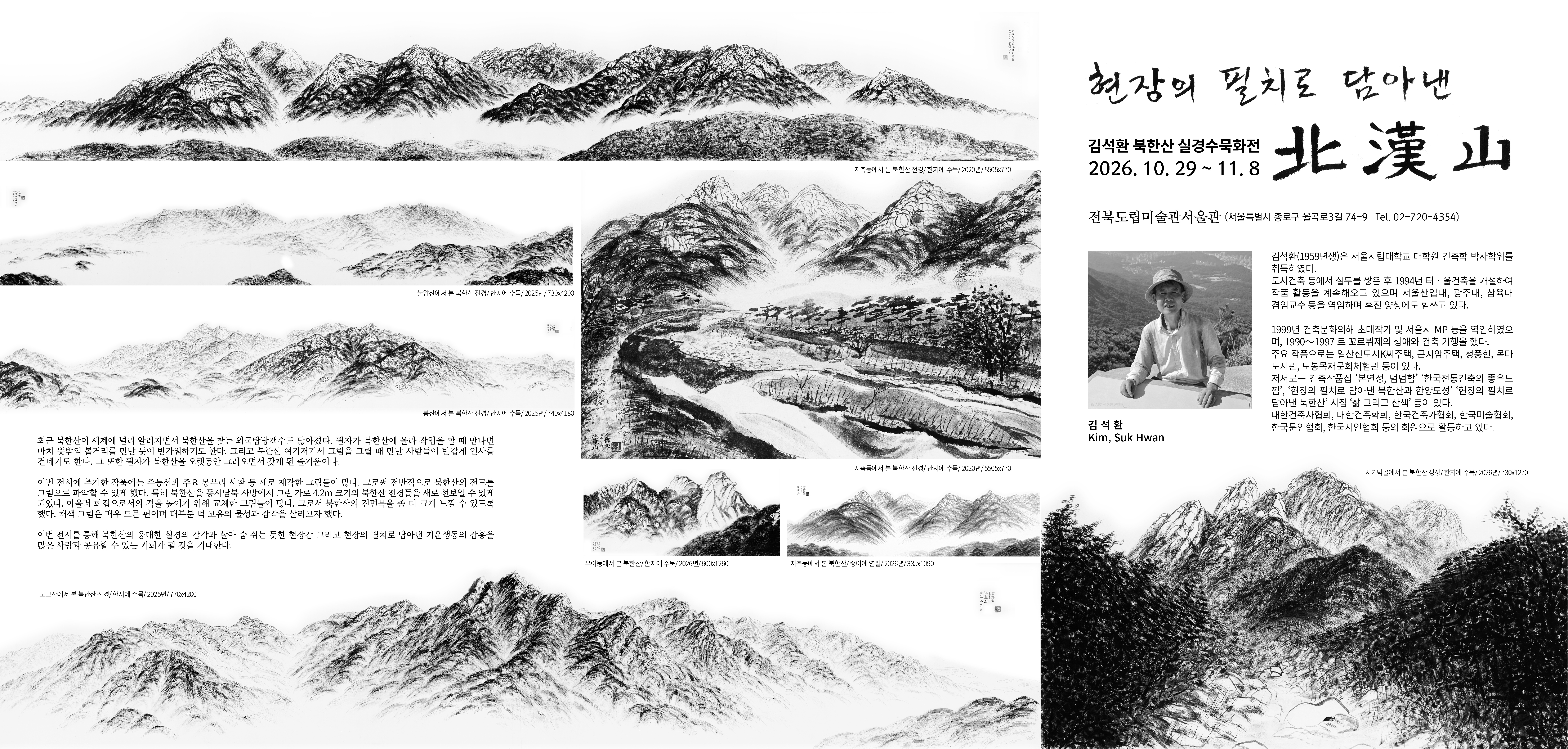
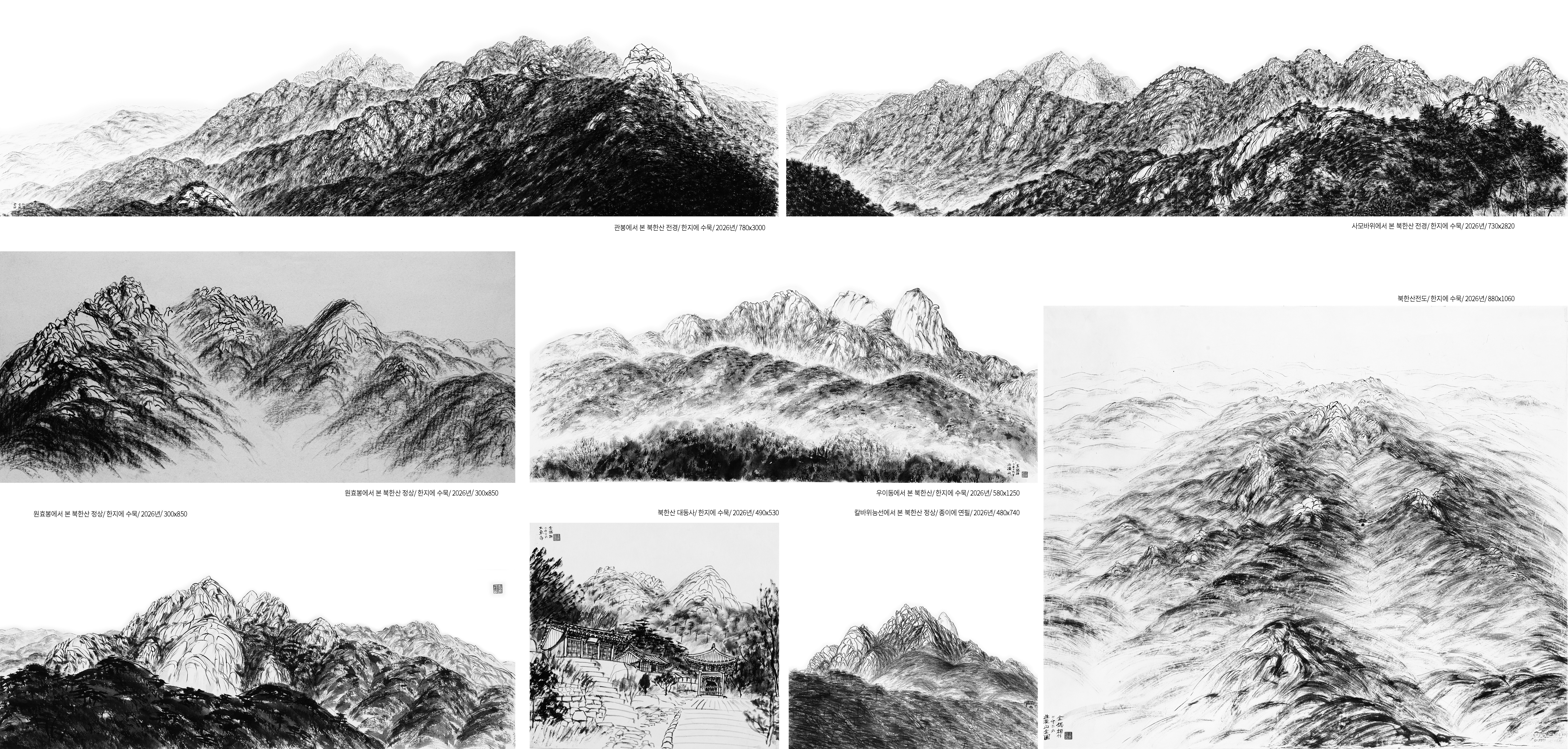
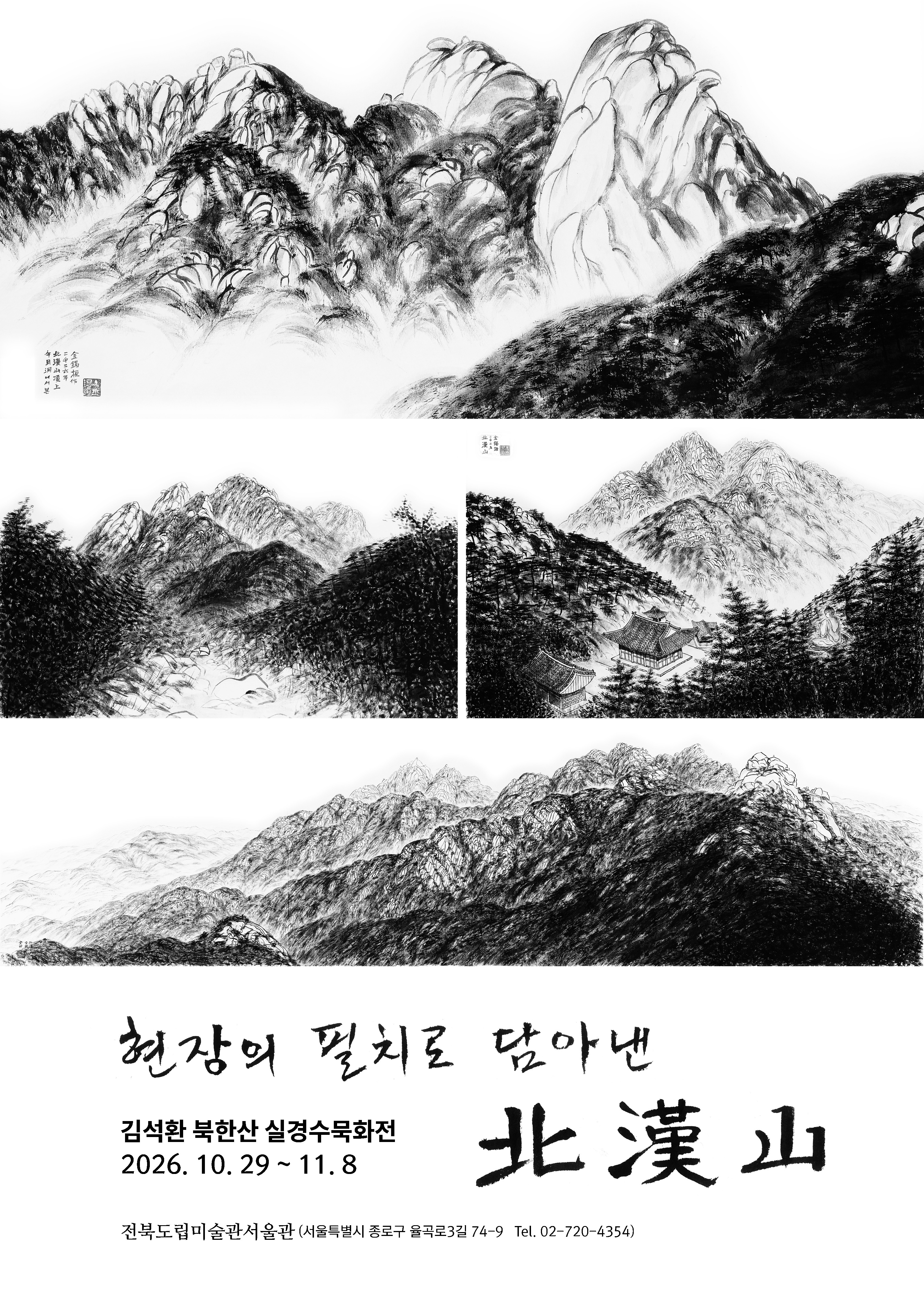
2026 전북도립미술관 서울관 북한산전
전시를 열면서...
2021년 북한산 실경수묵화전에 이어 다시 북한산 그림을 선보이게 되었다. 그 후에도 거의 매주 북한산을 오르며 꾸준히 그려왔고 새로운 그림들이 쌓이게 되었다. 시간이 흐르며 문득 그림에 담긴 북한산의 면모가 이전보다 내 안에 좀 더 만족스레 다가왔다. 이번에 다시 북한산 그림전을 하게 된 것은 그처럼 새롭게 제작된 북한산 그림들을 펼쳐보이고자 한 것이다. 그리고 그 때 출판했던 ‘현장의 필치로 담아낸 북한산’ 개정판을 보완해 신개정판을 출판하게 되었다.
내가 북한산을 그리기 시작한 것은 20여전이다. 북한산 주말 산행을 시작한 시기이기도 하다. 나는 고적 답사나 해외 답사 등 어느 곳을 가거나 그림 도구를 휴대하고 그림을 그려왔다. 북한산을 다니기 시작하면서도 마주하는 빼어난 풍광에 이끌려 순간순간 그려왔다. 그러다 점차 역사 인식을 갖고 접근하기 시작하였다. 서울 역사 연구에 관심이 많은 서울시립대학원에서 석사 박사과정을 거치며 자연스레 서울의 입지에 주목을 하게 되었고 과거 선조들이 풍수지리 시각에서 관념적으로 인식해 온 서울의 산세를 쳬계적으로 그릴 결심을 갖게 되었다.
서울(한양)의 고지도에는 예외 없이 서울 주변의 산들과 물길이 골격을 형성하고 있다. 자형의 바탕 위에서 일궈온 전통적인 삶터의 시각이 반영된 것이라 할 수 있다. 그런데 거기에는 실제 형상과 달리 관념적 시각에 의해 강조한 부분도 있다.
북한산과 서울의 산을 자주 접하면서 점차 서울의 입지와 지형구조에 대한 이해가 높아 갔다. 그리고 과거 선조들이 주목해온 서울의 입지를 실경으로 담아두려는 생각을 갖게 되었다. 역사적 측면에서 퍽 의미 있게 여겨졌다. 그것이 서울의 입지를 본격적으로 그리게 된 계기이다. 그리고 2014년 서울도서관 초대 ‘북한산과 한양도성전’ 2016년 삼육대 박물관 초대 ‘북한산전’ 2022년 ‘불암산과 서울의 산’ 전북도립미술관 서울관의 2020년‘북한산과 한양도성전’ 2022년 ‘서울의 산하’ 2023년 ‘인왕산·백악산·북한산 전’ 등 많은 전시와 책자를 발간해왔다. 특히 그 중에서도 거의 매주 오르면서 빼어난 풍광에 감탄해온 북한산을 가장 많이 그리게 되었다.
나는 백두대간 종주, 낙동정맥 단독종주, 일본 북알프스 종주를 비롯하여 전국의 산들을 많이 다녀왔다. 그리고 그런 바탕에서 북한산의 빼어남을 더 깊이 인식하게 되었다. 북한산은 서울 화강암지대에 속하는 지질 특성에 따라 백운대 만경대 인수봉 등 거대한 화강암 봉우리가 우뚝 솟아나 산세의 위용을 드러낸다. 그 웅장하고 굳건한 풍광은 어디서도 쉽게 볼 수 없다. 그리고 주능선, 비봉능선, 의상능선, 상장능선 등이 그 정상 모습과 어우러져 수려한 풍광을 이룬다.
예부터 선조들은 금강산을 많이 찾았고 남겨진 그림도 많다. 금강전도, 만폭동도 등 많은 금강산 그림을 많이 남긴 겸재, 소정 등을 금강산 화가로 부르기도 한다. 그런데 실경과 비교할 때 그 그림들 만으로서는 전모를 이해하기 어려울 것 같다.
나는 북한산에 깊이 매료되면서 그 전모를 담아내려고 생각했다. 겸재가 그림 경교명승첩 등을 대하며 진경의 정신을 본받고자 했다. 그리고 전경, 원경, 주능선, 주요봉우리 및 계곡, 성곽 및 사찰 등 목차를 정하고 체계적으로 작업해왔다.
나의 실제 현장에서 마주하는 실경의 감동을 그림을 통해 느껴질 수 있게 하기 위해 현장 작업을 고수해왔다. 즉 그림을 감상하는 시각에서도 현장에서 바라볼 때처럼 감동을 느낄 수 있게 하고자 했다.
화가 건축가 시인으로 활동하고 있는 나의 그림에는 그러한 다양한 경험이 무의식적으로 반영될 것으로 생각한다. 설계도면 같은 사실적이고 치밀한 구도를 바탕에 갖추고 실재 풍경과 같은 균형감이 화면에 안정감을 갖게 하고자 한다. 그리고 실경의 감동을 시적 감흥을 살려 울림 있게 담아내고자 했다.
전에 진행했던 나의 전시를 본 사람들은 대체적으로 살아서 꿈틀거리는 것 같다는 소감을 예기했다. 그리고 독특한 화풍을 보인다고 한다. 나는 전통적 묘사의 기법에 의존하려 하지 않는다. 기법에 얽매이지 않고 현장에서 마주대하며 다가오는 실경의 감각을 최대한 드러내도록 하는데 집중한다. 즉 대상에 대한 감동을 신체적인 행위로 진솔하게 드러내고자 한다. 아울러 크고 무겁고 자연스러운 감각을 최대한 살리고자 한다.
나의 그림에는 실재 현장에서 마주대하는 풍광의 감흥을 빠른 필치로 화폭에 담아내는 과정에서 기운생동의 감각이 담긴다. 그처럼 실재 풍광에서 전해오는 생동감을 중시한다. 그래서 늘 현장 작업을 고수해 왔다.
최근 북한산이 세계에 널리 알려지면서 북한산을 찾는 외국탐방객수도 많아졌다. 필자가 북한산에 올라 작업을 할 때 만나면 마치 뜻밖의 볼거리를 만난 듯이 반가워하기도 한다. 그리고 북한산 여기저기서 그림을 그릴 때 만난 사람들이 반갑게 인사를 건네기도 한다. 그 또한 필자가 북한산을 오랫동안 그려오면서 갖게 된 즐거움이다.
이번 전시에 추가한 작품에는 주능선과 주요 봉우리 사찰 등 새로 제작한 그림들이 많다. 그로써 전반적으로 북한산의 전모를 그림으로 파악할 수 있게 했다. 특히 북한산을 동서남북 사방에서 그린 가로 4.2m 크기의 북한산 전경들을 새로 선보일 수 있게 되었다. 아울러 화집으로서의 격을 높이기 위해 교체한 그림들이 많다. 그로서 북한산의 진면목을 좀 더 크게 느낄 수 있도록 했다. 채색 그림은 매우 드문 편이며 대부분 먹 고유의 물성과 감각을 살리고자 했다.
이번 전시를 통해 북한산의 웅대한 실경의 감각과 살아 숨 쉬는 듯한 현장감 그리고 현장의 필치로 담아낸 기운생동의 감흥을 많은 사람과 공유할 수 있는 기회가 될 것을 기대한다.
2026년 10월
一梅憲에서 김석환
영문
2026 Bukhansan Exhibition, Jeonbuk Museum of Art, Seoul Branch
On Opening the Exhibition...
Following the 2021 Bukhansan Landscape Ink Painting Exhibition, I am presenting my paintings of Bukhansan once again. Since then, I have climbed Bukhansan almost every week and painted consistently, accumulating a collection of new works. As time passed, the facets of Bukhansan captured in my paintings suddenly resonated with me more satisfactorily than before. The reason for holding this Bukhansan painting exhibition again is to showcase these newly created paintings. Additionally, I have published a new revised edition of *Bukhansan Captured with the Brushstrokes of the Field*, supplementing the revised edition published at that time.
It was about 20 years ago that I began painting Bukhansan. This was also the time when I started my weekend hikes to Bukhansan. Whether for historical site visits or overseas expeditions, I have always carried my painting tools with me to draw wherever I went. Even after I began visiting Bukhansan, I was drawn by the magnificent scenery I encountered and painted moment by moment. Gradually, however, I began to approach the subject with a historical awareness. While pursuing my master's and doctoral degrees at the University of Seoul, where I had a keen interest in the study of Seoul's history, I naturally began to focus on the city's geographical location. I resolved to systematically depict the mountainous topography of Seoul, which our ancestors had conceptually perceived from a geomantic perspective.
In ancient maps of Seoul (Hanyang), the surrounding mountains and waterways invariably form the city's framework. This can be seen as a reflection of the perspective on traditional living spaces built upon the foundation of the city's shape. However, there are also aspects emphasized based on a conceptual viewpoint that differ from the actual landscape.
As I frequently encountered Bukhansan Mountain and the mountains of Seoul, my understanding of the city's location and topographical structure gradually deepened. Consequently, I conceived the idea of capturing the actual landscape of Seoul that our ancestors had focused on. I considered this to be highly significant from a historical standpoint. This served as the catalyst for me to begin depicting Seoul's location in earnest. Furthermore, I have organized numerous exhibitions and published many books, including the invited "Bukhansan and Hanyangdoseong Exhibition" at the Seoul Metropolitan Library in 2014, the invited "Bukhansan Exhibition" at Sahmyook University Museum in 2016, "Buramsan and the Mountains of Seoul" in 2022, and exhibitions at the Jeonbuk Museum of Art, Seoul Branch—such as "Bukhansan and Hanyangdoseong Exhibition" in 2020, "The Mountains and Rivers of Seoul" in 2022, and the "Inwangsan, Baegaksan, and Bukhansan Exhibition" in 2023. In particular, I have come to paint Bukhansan the most, as I have climbed it almost every week and marveled at its magnificent scenery.
I have traveled extensively across mountains throughout the country, including traversing the Baekdudaegan, a solo traverse of the Nakdongjeongmaek, and the Northern Alps of Japan. It is against this backdrop that I have come to recognize the exceptional beauty of Bukhansan more deeply. Due to its geological characteristics belonging to the Seoul granite zone, massive granite peaks such as Baegundae, Mangyeongdae, and Insubong rise majestically, revealing the grandeur of the mountain landscape. That magnificent and steadfast landscape is not easily found anywhere else. The main ridge, Bibong Ridge, Uisang Ridge, and Sangjang Ridge harmonize with the peaks to form a magnificent scenery.
Since ancient times, our ancestors frequently visited Mt. Geumgang, leaving behind many paintings. Artists such as Gyeomjae and Sojeong, who left behind numerous paintings of Mt. Geumgang including *Geumgangjeondo* and *Manpokdongdo*, are often referred to as "painters of Mt. Geumgang." However, when compared to the actual scenery, it seems difficult to grasp the full scope of the landscape solely through these paintings.
Deeply captivated by Mt. Bukhansan, I resolved to capture its full grandeur. I sought to emulate the spirit of "true landscape" (Jingyeong) by encountering works such as Gyeomjae's *Gyeonggyo Myeongseungcheop*. I established a table of contents covering foreground, background, main ridge, major peaks and valleys, fortresses, and temples, and have been working systematically.
I have adhered to working on-site to ensure that the emotional impact of the actual scenery I encounter can be felt through my paintings. In other words, I aimed to allow viewers to experience the same sense of awe and wonder as they would when viewing the site in person.
I believe that my diverse experiences as a painter, architect, and poet are unconsciously reflected in my paintings. I aim to establish a foundation of realistic and meticulous composition, akin to a blueprint, and to bring stability to the canvas through a sense of balance reminiscent of actual landscapes. Furthermore, I sought to capture the emotional resonance of real scenery with poetic inspiration.
Those who viewed my previous exhibitions generally remarked that the works seemed to come alive and pulsate. They also noted that I display a unique style. I do not attempt to rely on traditional descriptive techniques. Instead of being bound by technique, I focus on revealing the sensations of the real landscape encountered on-site to the fullest extent. In other words, I seek to sincerely express my emotion toward the subject through physical action. Additionally, I aim to bring out a sense of grandeur, weight, and naturalness to the fullest.
My paintings contain a sense of vibrant energy as I capture the inspiration of the scenery encountered in the field onto the canvas with rapid brushstrokes. I place great importance on the vitality conveyed from actual landscapes in this way. For this reason, I have always adhered to working on-site.
Recently, as Bukhansan has become widely known to the world, the number of foreign visitors has increased. When I meet them while climbing Bukhansan to work, they greet me with delight, as if they have discovered an unexpected sight. Also, people I meet while painting here and there on Bukhansan greet me warmly. That, too, is a joy I have come to develop while painting Bukhansan for a long time.
The works added to this exhibition include many newly created paintings of the main ridge, major peaks, and temples. This allows viewers to grasp the full scope of Bukhansan through the paintings. In particular, I am able to present new panoramic views of Bukhansan, measuring 4.2 meters in width, drawn from all four directions: east, west, north, and south. Furthermore, many paintings have been replaced to elevate the quality of the art book. This allows viewers to experience the true essence of Bukhansan on a larger scale. Colored paintings are quite rare; I have mostly sought to bring out the inherent physical properties and sensibility of ink.
I look forward to this exhibition serving as an opportunity to share with many people the sense of the majestic real-life scenery of Bukhansan Mountain, the living, breathing sense of presence, and the vibrant energy captured through the brushstrokes of the site.
October 2026
Kim Seok-hwan at Ilmaeheon


회원약관
제1조(목적 등)
① 인터넷 (사)한국미술협회 (www.kfaa.or.kr) 이용자 약관(이하 "본 약관")은 이용자가 ㈜IAC(Interactive Art Communications)(이하 "미협")에서
제공하는 인터넷 관련 서비스(이하 "서비스")를 이용함에 있어 이용자와 미협의 권리·의무 및 책임사항을 규정함을 목적으로 합니다.
② 이용자가 되고자 하는 자가 미협이 정한 소정의 절차를 거쳐서 "동의" 단추를 누르면 본 약관에 동의하는 것으로 간주합니다.
본 약관에 정하는 이외의 이용자와 미협의 권리, 의무 및 책임사항에 관해서는 전기통신사업법 기타 대한민국의 관련 법령과 상관습에 의합니다.
제2조(이용자의 정의)
"이용자"란 미협에 접속하여 본 약관에 따라 인터넷 미협 회원(이하 "미협회원")으로 가입하여 미협이
제공하는 서비스를 받는 자를 말합니다.
제3조 (회원 가입)
① 이용자가 되고자 하는 자는 미협이 정한 가입 양식에 따라 회원정보를 기입하고 "등록하기" 단추를 누르는 방법으로 회원 가입을 신청합니다.
② 미협은 제1항과 같이 회원으로 가입할 것을 신청한 자가 다음 각 호에 해당하지 않는 한 신청한 자를
회원으로 등록합니다.
저작권 정책
본 웹 사이트에 게재된 내용들을 내부 정보 자료로 이용하거나 자료의 복사본이나 일부분을 저작권 표기와 함께 사적, 비상업적인 정보 제공의 목적으로 사용할 수 있습니다.
이 사이트에 있는 모든 자료들은 한국미술협회이 저작권을 가지고 있으며, 자료에서 언급되는 제품이나 프로세스, 또는 기술 등은 한국미술협회이 가진 지적 재산권의 대상이 되며, 라이센스를 허락하지 않습니다. 한국미술협회은 제공되는 정보를 다른 목적으로 이용한 경우에 대해 어떠한 종류의 명시 혹은 묵시적인 보증도 하지 않습니다. 사법권이 암묵적 보증의 배제를 허용하지 않는 일부 관할권내에서는 그 보증의 배제조항의 일부분이 여러분에게 적용되지 않을 수 있습니다.
한국미술협회의 홈페이지를 통하여 연결된 타 사이트들에 대한 보증이나 그 내용의 인증 역시, 한국미술협회은 하지 않으며, 이들 사이트를 이용하여 생긴 손실이나 데이터의 손실에 대해서도 책임을 지지 않음을 알려 드립니다.
개인정보보호정책
본 내용은 어떤 종류의 개인정보를 취하고, 또 그것을 어떻게 사용할 것인지에 대해 안내하고 있습니다.
또한 회원님 개인의 프라이버시와 관련된 몇 가지 중요한 사항을 정리해 놓았습니다.
1. 총칙
사단법인 한국미술협회(이하 “미술협회”)가 취급하는 모든 개인정보는 관련법령에 근거하거나 정보주체의 동의에 의하여 수집보유 및 처리되고 있습니다.「공공기관의 개인정보보호에 관한 법률」은 이러한 개인정보의 취급에 대한 일반적 규범을 제시하고 있으며, 미술협회는 이러한 법령의 규정에 따라 수집보유 및 처리하는 개인정보를 공공업무의 적절한 수행과 국민의 권익을 보호하기 위해 적법하고 적정하게 취급할 것입니다.
또한, 한국미술협회는 관련 법령에서 규정한 바에 따라 보유하고 있는 개인정보에 대한 열람청구권 및 정정청구권 등 여러분의 권익을 존중하며, 여러분은 이러한 법령상 권익의 침해 등에 대하여 행정심판법에서 정하는 바에 따라 행정심판을 청구할 수 있습니다.
다음은 미술협회의 개인정보보호방침은 마술협회가 운영하는 여러 홈페이지에서 이용자 여러분의 개인정보를 보호하기 위한 [홈페이지 이용자의 개인정보 보호]와 소관업무를 수행하는데 필요한 개인정보 취급에 대한 [컴퓨터에 의해 처리되는 개인정보 보호] 두 가지로 구성되어 있습니다. 먼저 [홈페이지 이용자의 개인정보 보호]에 대하여 설명 드리겠습니다.
2. 한국미술협회 홈페이지에서의 개인정보보호
본 사이트는 미술협회의 웹사이트입니다. 미술협회 홈페이지의 이용에 대해 감사 드리며, 홈페이지에서의 개인정보보호방침은 현행 「공공기관의 개인정보보호에 관한 법률」 및 [공공기관의 개인정보보호를 위한 기본지침]에 근거를 두고 있습니다. 미술협회 웹사이트는 다음과 같으며, 이 방침은 별도의 설명이 없는 한 미술협회에서 운용하는 모든 웹사이트에 적용됨을 알려드립니다.
3. 수집저장되는 정보
여러분이 미술협회 홈페이지를 이용할 경우 다음의 정보는 (홈페이지 이용자의 기재에 의한) 수동 또는 자동으로 수집,저장됩니다.
- 이용자 여러분의 인터넷서버 도메인명과 우리 홈페이지를 방문 할 때 거친 웹사이트의 주소, 방문일시 등
위와 같이 수집,저장되는 정보는 이용자 여러분에게 보다 나은 서비스를 제공하기 위해 홈페이지의 개선과 보완을 위한 통계분석, 이용자와 웹사이트간의 원활한 의사소통 등을 위해 이용되어질 것입니다. 다만, 법령의 규정에 따라 이러한 정보를 제출하게 되어 있을 경우도 있다는 것을 유념하시기 바랍니다.
4. 쿠키에 의한 개인정보수집
미술협회는 웹사이트의 정보를 저장하고 수시로 찾아내는 '쿠키(cookie)'를 사용합니다.
쿠키는 웹사이트가 귀하의 컴퓨터 브라우저(넷스케이프, 인터넷 익스플로러 등)로 전송하는 소량의 정보입니다.
웹사이트에 접속을 하면 미술협회의 컴퓨터는 귀하의 브라우저에 있는 키의 내용을 읽고, 귀하의 추가정보를 귀하의 컴퓨터에서 찾아 접속에 따른 성명 등의 추가 입력 없이 서비스를 제공할 수 있습니다. 쿠키는 사용자의 컴퓨터는 식별하지만 개인적으로 식별하지는 않습니다.
5. 요청하지 않은 이메일 및 웹 서식 등을 통한 수집정보
미술협회에서는 회원들에게 다양한 정보를 이메일 등을 통하여 제공(발송)하고 있습니다. 이는 이메일 서비스 정보수신에 동의한 회원 이메일로 제공되며, 만일 더 이상 정보수신을 원치 않는 경우에도 언제든지 수신거부 할 수 있습니다.
또한 이용자 여러분은 우편, 전화 또는 온라인 전자서식 등을 통한 전자적 방법을 통해 의사를 표시할 수 있습니다. 이러한 방법의 선택에 있어 몇 가지 유의사항을 알려드립니다.
- 여러분이 홈페이지에 기재한 사항은 다른 사람들이 조회 또는 열람할 수도 있습니다.
- 여러분이 기재한 사항은 관련 법규에 근거하여 필요한 다른 사람과 공유될 수 있으며, 관련법령의 시행과 정책개발의 자료로도 사용될 수 있습니다.
- 또한, 이러한 정보는 타 부처와 공유되거나, 필요에 의하여 제공될 수도 있습니다.
6. 부가서비스 이용시 수집되는 개인정보
웹사이트에서 고객참여 및 회원 가입시에 미술협회에서는 필요한 최소한의 개인정보를 수집하며, 이에 대한 동의를 얻고 있습니다. 수집하는 개인정보 항목은 다음과 같습니다.
- 이름, 주민등록번호,주소, 전화번호, E-Mail
단 정회원의 경우에는 미술협회 데이터베이스와 연동되어 별도로 회원가입을 하지 않고 회원번호를 이용하여 접속 할 수 있습니다.
7. 개인정보의 수집,이용목적
미술협회 홈페이지에서 제공하는 서비스는 별도의 사용자등록 없이 언제든지 사용할 수 있습니다. 그러나, 미술협회에서는 이용자들에게 보다 더 향상된 양질의 서비스를 제공하기 위하여 이용자 개인의 정보를 수집하고 있으며 무책임한 음해성 문구나 비방을 감소시켜 이용자 여러분들의 의견수렴 효과성을 높이기 위해 게시판 글쓰기 시 실명을 확인하고 있습니다. 이를 위하여 회원가입을 하여야만 사용할 수 있도록 일부 기능을 제한하고 있습니다.
8. 웹사이트에서 운영하는 보안조치
홈페이지의 보안 또는 지속적인 서비스를 위해, 미술협회는 네트워크 트래픽의 통제(Monitor)는 물론 불법적으로 정보를 변경하는 등의 시도를 탐지하기 위해 여러가지 프로그램을 운영하고 있습니다.
9. 링크 사이트 웹 페이지
미술협회가 운영하는 웹페이지에 포함된 링크 또는 배너를 클릭하여 다른 사이트 또는 웹페이지로 옮겨갈 경우 개인정보보호방침은 그 사이트 운영기관이 게시한 방침이 적용됨으로 새로 방문한 사이트의 방침을 확인하시기 바랍니다.
10. 웹사이트 이용 중 다른 사람의 개인정보 취득
미술협회가 운영하는 웹사이트에서 이메일 주소 등 식별할 수 있는 개인정보를 취득하면 안됩니다.. 만약 기타 부정한 방법으로 이러한 개인정보를 열람 또는 제공받은 자는 [공공기관의개인정보보호에관한법률] 제23조의 규정에 의하여 처벌을 받을 수 있습니다.
11. 개인정보 침해사항의 신고
미술협회의 홈페이지 이용 중 개인정보의 유출 가능성 등 정보주체의 권익이 침해될 우려가 있는 사실을 발견하였을 경우는 다음의 연락처로 알려주시기 바랍니다.
한국미술협회
- 이메일 : kfaa1961@daum.net
- 전화번호 : 02-744-8053 Fax : 02-741-6240
- 주소 : 우)07995 서울특별시 양천구 목동서로 225 대한민국예술인센터 904호
12. 개인정보의 이용 및 제공의 제한
미술협회가 수집,보유하고 있는 개인정보는 일반 행정정보와 달리 이용 및 제공에 엄격한 제한이 있는 정보입니다. [공공기관의개인정보보호에관한법률] 제10조(이용 및 제공의 제한)는 이에 관하여 다음과 같이 규정하고 있습니다.
- 다른 법률에 의해 보유기관 내부에서 이용하거나 보유기관이외의 자에게 제공하는 경우
- 아래의 경우
- 정보주체의 동의가 있거나 또는 정보주체에게 제공하는 경우
- 다른 법률에서 정하는 소관업무를 수행하기 위해 당해 처리정보를 이용할 상당한 이유가 있는 경우 - 조약 기타 국제협정의 이행을 위해 외국정부 또는 국제기구에 제공하는 경우, 통계작성 및 학술연구 등의 목적을 위해 특정개인을 식별 할 수 없는 형태로 제공하는 경우 - 정보주체 또는 그 법정대리인이 의사표시를 할 수 없는 상태로 놓여 있거나 주소불명 등으로 동의를 할 수 없는 경우로써 정보주체 외의 자에게 제공하는 것이 명백히 정보주체에게 이익이 된다고 인정되는 경우
- 범죄의 수사와 공소의 제기 및 유지에 필요한 경우
- 법원의 재판업무수행을 위하여 필요한 경우
- 기타 대통령령이 정하는 특별한 사유가 있는 경우
- 예술위원회는 개인정보의 이용 및 제공에 있어 관계법령을 엄수하여 부당하게 이용되지 않도록 노력하겠습니다.
13. 권익침해 구제방법 (「공공기관의개인정보보호에관한법률의 경우)
「공공기관의개인정보보호에관한법률」 제12조(처리정보의 열람) 제1항 및 제14조제1항(처리정보의 정정)의 규정에 의한 청구에 대하여 공공기관의 장이 행한 처분 또는 부작위로 인하여 권리 또는 이익이 침해를 받은 자는 행정심판법이 정하는 바에 따라 행정심판을 청구할 수 있습니다.
※ 행정심판에 대한 자세한 사항은 법제처(http://www.moleg.go.kr)에서 제공하는 다음의 링크사이트를 참고하시기 바랍니다.
또는 정부에서 설치하여 운영중인 개인정보침해신고센터(http://www.cyberprivacy.or.kr, 전화 02-1336, PC통신 go eprivacy)에 불만처리를 신청할 수 있습니다.
※ 행정심판위원회 전화번호 안내(법제처 홈페이지 참조)
14. 개인정보보호책임담당자의 이메일 등 연락처
한국미술협회는 개인정보의 적법성 및 절차의 적정성을 확보하여 국민의 권익보호 및 공공업무의 적정한 수행을 도모하기 위해 개인정보보호책임관을 다음과 같이 지정,운영하고 있습니다. 우리 위원회가 보유하고 있는 개인정보화일과 우리 위원회의 개인정보보호방침 등에 관한 문의,확인 등은 다음의 연락처로 하여 주시기 바랍니다.
[한국미술협회]
- 이메일 : kfaa1961@daum.net
- 전화번호 : 02-744-8053 Fax : 02-741-6240
- 주소 : 우)07995 서울특별시 양천구 목동서로 225 대한민국예술인센터 904호
이메일 무단수집 거부
본 웹 사이트에 게시된 이메일 주소가 전자우편 수집 프로그램이나 그 밖의 기술적 장치를 이용하여 무단으로 수집되는 것을 거부하며, 이를 위반 시 정보통신망법에 의해 형사처벌됨을 유념하시기 바랍니다.
(게시일 2022년 9월 27일)